Lucknow is a city where festivals are not just celebrated—they are experienced.
Lucknow is a city where festivals are not just celebrated—they are experienced.

From beautiful religious traditions to colourful fairs, cultural gatherings, family outings and local celebrations, every festival brings a different side of the city to life. And this year, Hariyali Teej brought a particularly beautiful festive atmosphere to Lucknow.
On August 15, 2026, while India was celebrating its Independence Day, people were also celebrating Hariyali Teej, an important Hindu festival associated with the monsoon season, greenery, devotion and the divine relationship between Lord Shiva and Goddess Parvati.

In Lucknow, a special Hariyali Teej celebration was organised at the Khatu Shyam Ji Temple located on Birbal Sahani Marg. The event brought together devotion, a festive fair, stalls, competitions, prizes and plenty of excitement for visitors.
We from Bite and Roam visited the event to capture the atmosphere and experience what made this celebration special.
And honestly, it was much more than just a religious gathering.

It felt like a complete festive experience where people could pray, explore the fair, participate in competitions, spend time with family and enjoy the lively atmosphere of the occasion.
So, if you have never experienced Hariyali Teej before, especially if you are reading this from outside India, let us take you through this beautiful festival and tell you what we experienced in Lucknow.
What is Hariyali Teej?

Hariyali Teej is a traditional Hindu festival celebrated during the monsoon season, particularly during the month of Sawan in the Hindu lunar calendar.
The word “Hariyali” means greenery.
This is an important clue to understanding the festival.
During the monsoon season, the dry landscape of India begins to transform. Rain brings fresh greenery to trees, plants and fields, the weather becomes cooler and the entire environment feels refreshed.
Hariyali Teej celebrates this beautiful transformation of nature along with religious and cultural traditions.
The festival is especially associated with Goddess Parvati and Lord Shiva.

According to Hindu traditions, Goddess Parvati performed intense devotion and penance to be united with Lord Shiva. Her dedication and devotion are an important part of the religious significance associated with Teej.
Because of this connection, Hariyali Teej is traditionally associated with love, devotion, marital happiness and family well-being.
The festival has a particularly special place in the lives of women.
Many married women observe a fast and offer prayers for the well-being and long life of their husbands and for happiness in their families. Unmarried women may also observe the festival while praying for a happy married life and a good life partner.
However, Hariyali Teej is not limited to fasting and prayers.
It is also a celebration of culture, nature, family and community.
Women often wear green traditional clothes, decorate their hands with mehendi, wear green bangles and participate in festive gatherings.

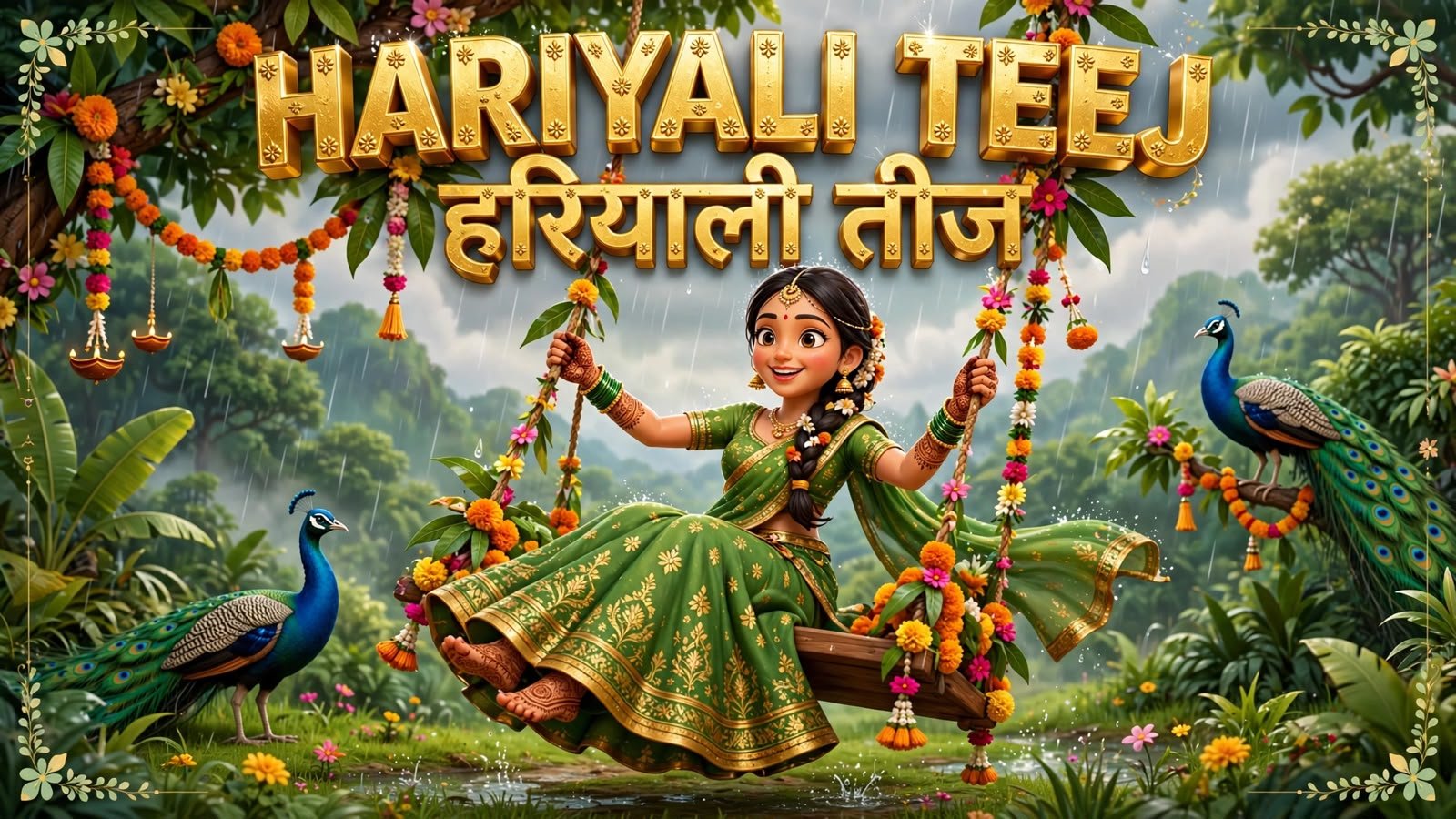
In many parts of India, swings are also associated with the festival, especially because of the beautiful monsoon atmosphere.

For someone unfamiliar with Indian festivals, Hariyali Teej can therefore be understood as a beautiful combination of spirituality, nature, tradition, family and celebration.
Hariyali Teej and the Beauty of the Monsoon
One of the most beautiful aspects of Hariyali Teej is its connection with the monsoon.
India has a very strong seasonal relationship with rain.
After the intense heat of summer, the arrival of monsoon brings relief and changes the landscape dramatically.
Trees become greener.

Plants begin to flourish.

The air becomes cooler.
Clouds cover the sky.

And the entire environment feels alive again.
This seasonal transformation is reflected in the spirit of Hariyali Teej.
That is why green is such an important colour during the festival.
Green represents nature, freshness, growth and new beginnings.

Women wearing green sarees, suits or lehengas, green bangles and mehendi-covered hands are a familiar sight during Hariyali Teej celebrations across many parts of India.
For visitors from other countries, this is one of the easiest ways to understand why the festival is called “Hariyali Teej”—the Festival of Greenery.
A Special Hariyali Teej Celebration in Lucknow
This year, Lucknow witnessed a special Hariyali Teej celebration at the Khatu Shyam Ji Temple on Birbal Sahani Marg.

The temple became a gathering place for devotees and local visitors who came to celebrate the festival and enjoy the special programme organised for the occasion.
There was a festive atmosphere around the event, with people arriving with their families and friends.
Visitors could experience the religious side of the celebration while also enjoying the fair and various activities organised as part of the programme.
For us at Bite and Roam, this made the event particularly interesting.
We were not simply visiting a temple.
We were experiencing a local celebration where religion, community and entertainment came together.
The atmosphere had the energy that you usually associate with Indian festivals—people moving around, families spending time together, children exploring the event and visitors enjoying the different attractions.
The Fair Added a Different Energy
One of the attractions of the Hariyali Teej celebration was the fair organised around the event.
Several stalls were set up for visitors.

This is one of the things that makes Indian religious festivals so interesting.
A festival often becomes much more than a ceremony.
It becomes a community gathering.
People come for prayers and blessings, but they also meet relatives, spend time with friends, take photographs, explore stalls and enjoy the festive atmosphere.
For children, a fair can be one of the most exciting parts of the experience.
For adults, it becomes an opportunity to spend quality time with family and reconnect with cultural traditions.
And for visitors from outside India, such a fair offers a wonderful glimpse into everyday Indian community life.
You can see how religion and social life naturally come together during festivals.
Competitions Made the Celebration Even More Exciting
Another major attraction of the event was the series of competitions organised during the celebration.
Instead of simply watching the programme, visitors had the opportunity to participate.
This added a completely different level of excitement.
Whenever competitions are included in a festival, people become more involved.
Participants get a chance to showcase their talent or skills, while the audience cheers for them and waits to see who wins.
It turns a gathering into an interactive celebration.
At the Khatu Shyam Temple’s Hariyali Teej event, the competitions became one of the highlights of the programme.
People participated enthusiastically, while others watched and encouraged the participants.
And then came the part that created even more excitement—the prizes.
The First Prize Was a Honda Scooter
The biggest prize of the competition was a Honda scooter.
Yes, the winner of the first prize received a Honda scooter.

That is certainly not the kind of prize you forget easily.
Imagine arriving at a festive celebration, participating in a competition and then discovering that you have won a scooter.
For the winner, this must have been an unforgettable moment.
A prize like this also adds excitement to the entire competition because participants know that something substantial is waiting for the winner.
It encourages people to participate and gives the audience another reason to stay engaged with the programme.
The Honda scooter became one of the most talked-about highlights of the competition.
Other Winners Received 50-Gram Silver Coins
The prizes were not limited to the first-place winner.
Other winners also received special prizes.
According to the event information shared with us, other winners were awarded 50-gram silver coins.

Silver has traditionally been considered auspicious in Indian culture.
It is often associated with prosperity, purity and good fortune, which makes a silver coin a particularly meaningful prize at a religious or cultural celebration.
So, while the first prize attracted attention because of the Honda scooter, the silver coins also made the competition memorable for the other winners.
It was a nice way to recognise the participation and efforts of multiple people rather than focusing only on one winner.
Why Are Women So Closely Associated With Hariyali Teej?

If you are discovering Hariyali Teej for the first time, you may notice that women have a particularly prominent role in the festival.
There is a strong cultural tradition of women celebrating Teej together.
Married women may observe the fast and pray for the well-being and longevity of their husbands and the happiness of their families.
Unmarried women may pray for a happy married life and a suitable life partner.
But there is another important social aspect of the festival.
Hariyali Teej creates an opportunity for women to come together.
They dress traditionally, apply mehendi, wear bangles, sing traditional songs, enjoy swings and celebrate with friends and family.
In this way, the festival combines religious devotion with social bonding.
It is not simply about performing a ritual.
It is also about celebrating relationships, friendship and community.
The Importance of Green During Hariyali Teej
Green is perhaps the most recognisable colour associated with Hariyali Teej.
The reason is closely connected to the monsoon.
During Sawan, nature becomes green and fresh after the rains.
Green therefore represents life, growth, freshness and prosperity.
Women traditionally wear green clothes and bangles during the festival.
Mehendi is also an important part of the celebration.
In many Indian communities, getting mehendi applied is itself a festive activity.
Groups of women and girls gather together, decorate their hands and celebrate the occasion.
For an international visitor, the colours and clothing associated with Hariyali Teej can be one of the most visually beautiful parts of the celebration.
The Tradition of Swings During Teej
Swings are another popular cultural symbol associated with the monsoon season and Teej celebrations.
In many parts of India, swings are hung from trees during the rainy season.
Women and girls traditionally enjoy swinging while singing seasonal songs.
The tradition reflects the joy associated with the arrival of the monsoon.
Although modern urban life has changed many traditional practices, festivals like Hariyali Teej continue to keep these cultural memories alive.
Even when the celebration takes place in a city like Lucknow, the spirit of the old monsoon traditions remains present.
A Festival That Brings Families Together
One of the most beautiful things about festivals is their ability to bring families together.
Modern life can be extremely busy.
People have work, school, business, studies and countless daily responsibilities.
Festivals create an excuse to pause.
Families go out together.
Children get to experience something different.
Parents and grandparents get to share traditions with younger generations.
And everyone gets an opportunity to create new memories.
The Hariyali Teej celebration at the Khatu Shyam Ji Temple offered exactly this kind of experience.
People could visit the temple, participate in the celebration, explore the fair and spend time together.
For children, the fair provided excitement.
For adults, the religious atmosphere provided a sense of devotion and connection.
For families, the entire event became a shared experience.
The Religious Atmosphere at Khatu Shyam Temple
The location of the celebration also made the event special.
The programme was held at the Khatu Shyam Ji Temple on Birbal Sahni Marg in Lucknow.
For devotees, visiting a temple during a festival is naturally more meaningful than visiting on an ordinary day.
There is a special atmosphere around religious celebrations.
People arrive with faith and devotion.
They pray.
They seek blessings.
They participate in the celebrations.
And they return home with memories of the day.
The presence of the temple gave the Hariyali Teej programme a strong spiritual character while the fair and competitions added a festive and community-oriented side.
Understanding Khatu Shyam Ji for International Visitors
If you are reading this from outside India, you may be wondering who Khatu Shyam Ji is.
Khatu Shyam Ji is a widely revered figure among devotees, particularly associated with the town of Khatu in Rajasthan.
Devotees across India visit temples dedicated to Khatu Shyam Ji and consider him a powerful symbol of faith and devotion.
The name “Shyam” is widely used by devotees with affection and reverence.
Temples dedicated to Khatu Shyam Ji can be found in different cities across India, allowing devotees who cannot travel to Rajasthan to worship closer to home.
The temple in Lucknow is one such place where devotees can come for prayers and religious gatherings.
Lucknow and Its Living Culture
Lucknow is famous for its heritage, hospitality and tehzeeb.
But the culture of Lucknow is not limited to historic monuments.
The city’s culture is also visible in its festivals, religious gatherings, local markets and community celebrations.
Events like Hariyali Teej show how traditions continue to remain relevant even in a modern city.
People may live modern lifestyles, use smartphones and spend much of their time online, but when a festival arrives, they still come together.
They dress traditionally.
They visit temples.
They participate in cultural activities.
They celebrate with family.
That combination of modern life and traditional culture is one of the things that makes Indian cities so fascinating.
Why Local Festivals Are Worth Exploring
For travellers, local festivals can sometimes provide a much deeper understanding of a place than visiting famous tourist attractions alone.
A monument can tell you about history.
A museum can tell you about art.
But a local festival can show you how people actually live their culture.
You see families gathering.
You hear traditional conversations and prayers.
You see traditional clothing.
You experience local food and festive stalls.
You observe community traditions.
And most importantly, you become part of an experience rather than simply looking at something from a distance.
That is exactly why local festivals are so interesting for travellers.
They provide a window into the everyday cultural life of a place.
August 15, 2026: A Unique Combination of Two Celebrations
This year’s date made the celebration even more interesting.
August 15 is India’s Independence Day.
It is one of the most important national days in the country and commemorates India’s independence from British rule.
In 2026, August 15 also coincided with Hariyali Teej.
So the day brought together two very different kinds of celebration.
One was national and patriotic.
The other was religious and cultural.
Across India, people celebrated Independence Day while also observing the traditions of Hariyali Teej.
This made August 15, 2026, an especially memorable date for many people.
In Lucknow, the festive atmosphere around Hariyali Teej added another layer of celebration to an already important day.
Bite and Roam’s Experience
At Bite and Roam, we love exploring experiences that tell a story about a place.
For us, travelling is not simply about checking famous locations off a list.
It is about discovering the atmosphere of a place.
It is about meeting people.
It is about understanding local traditions.
It is about finding those small experiences that make a city feel alive.
The Hariyali Teej celebration at the Khatu Shyam Ji Temple was exactly that kind of experience.
We saw devotion.
We saw families spending time together.
We saw the energy of a local fair.
We saw people participating in competitions.
We saw the excitement surrounding the prizes.
And we saw how a religious festival can bring an entire community together.
These are the moments that make local experiences memorable.
What Made This Celebration Special?
If we had to describe the main highlights of the event, there would be several.
First, the celebration of Hariyali Teej itself.
Second, the spiritual atmosphere of the Khatu Shyam Ji Temple.
Third, the fair and various stalls organised for visitors.
Fourth, the competitions that encouraged people to participate.
Fifth, the Honda scooter awarded as the first prize.
Sixth, the 50-gram silver coins given to other winners.
And finally, the enthusiasm of the people who came to enjoy the celebration.
All of these elements came together to create a memorable festive experience.
Why Festivals Like Hariyali Teej Still Matter
In today’s digital world, we can see almost anything online.
We can watch videos of festivals from thousands of kilometres away.
We can see photographs of temples.
We can learn about traditions through social media.
But experiencing a festival in person is completely different.
When you stand among the crowd, hear the sounds around you, see people dressed for the occasion and experience the atmosphere yourself, you understand the culture in a much deeper way.
Festivals also help pass traditions from one generation to another.
Children can see how their parents and grandparents celebrate.
They can learn why a festival is important.
They can understand the stories and traditions behind it.
And they can create their own memories.
This is why festivals like Hariyali Teej continue to matter even in modern urban life.
A Beautiful Blend of Faith and Celebration
Perhaps the best way to describe the Hariyali Teej event at the Khatu Shyam Ji Temple is as a blend of faith and celebration.
There was devotion.
There was a festive fair.
There were stalls.
There were competitions.
There were prizes.
There were families.
There were children.
There were visitors.
And there was a strong sense of community.
The event showed that religious celebrations can also become beautiful social experiences.
People come together not only to pray, but also to share happiness.
That is one of the most beautiful aspects of Indian festivals.
Things to Keep in Mind When Visiting Religious Events
If you are planning to visit a temple or religious festival in India, there are a few simple things worth remembering.
Dress respectfully, especially when entering a temple.
Follow the instructions given by temple authorities.
Be patient if there is a crowd.
Take care of children and elderly family members.
Avoid littering.
Respect photography restrictions wherever they apply.
And most importantly, respect the religious significance of the place.
A little awareness and respect can make the experience comfortable for everyone.
Why You Should Experience Local Festivals in Lucknow
If you live in Lucknow or are visiting the city, local festivals can be a wonderful way to experience another side of the city.
You may already know Lucknow for its historical architecture, famous food, traditional culture and famous landmarks.
But there is another Lucknow that comes alive during religious festivals.
It is the Lucknow of neighbourhood temples, community gatherings, local fairs and family celebrations.
It is a side of the city that you cannot fully understand through guidebooks alone.
You have to experience it.
And events like the Hariyali Teej celebration at the Khatu Shyam Ji Temple provide exactly that opportunity.
Final Thoughts
The Hariyali Teej celebration at the Khatu Shyam Ji Temple on Birbal Sahani Marg in Lucknow was a beautiful example of how a traditional festival can bring people together.
There was devotion at the temple.
There was excitement in the fair.
There were stalls for visitors.
There were competitions for participants.
There were attractive prizes for the winners.
The first-prize winner received a Honda scooter, while other winners received 50-gram silver coins.
But beyond the prizes and activities, the most beautiful part of the celebration was the atmosphere.
People came together.
Families spent time with each other.
Devotees visited the temple.
Participants enjoyed the competitions.
Children explored the fair.
And everyone became part of a shared festive experience.
That is what makes festivals special.
They are not simply dates on a calendar.
They are moments when people pause their busy lives, come together, celebrate their traditions and create memories.
Hariyali Teej beautifully represents this idea.
It celebrates greenery and the arrival of the monsoon.
It celebrates devotion to Lord Shiva and Goddess Parvati.
It celebrates family, relationships and cultural traditions.
And it reminds us that even in a rapidly changing world, traditions can continue to bring people together.
For international visitors, Hariyali Teej is also a fascinating example of India’s cultural diversity.
It shows how religion, nature, seasonal changes, traditional clothing, family gatherings, music, fairs and community celebrations can all become part of one festival.
And experiencing such a celebration in Lucknow makes the experience even more special.
At Bite and Roam, we believe that exploring a city is about more than visiting famous places.
It is about discovering the stories behind them.
It is about understanding local culture.
It is about meeting people.
It is about experiencing festivals.
And it is about finding those little moments that make a trip memorable.
The Hariyali Teej celebration at Khatu Shyam Ji Temple was one of those experiences.
If you enjoy discovering local festivals, religious places, cultural events and interesting experiences around Lucknow, keep following Bite and Roam.
We will continue bringing you stories from places, events and experiences that deserve to be discovered.
Because travelling is not just about seeing a new place.
It is about understanding it.
It is about experiencing it.
And it is about taking a little piece of that experience with you when you leave.
Jai Shri Shyam.
Frequently Asked Questions About Hariyali Teej
What is Hariyali Teej?
Hariyali Teej is a Hindu festival celebrated during the monsoon season. It is associated with Lord Shiva and Goddess Parvati and is especially significant for women. The festival celebrates devotion, marital happiness, family well-being and the beauty of nature during the rainy season.
Why is Hariyali Teej called the Festival of Greenery?
Hariyali means greenery. The festival takes place during the monsoon season when trees, plants and landscapes become green and fresh after the rains. Green clothing and bangles are therefore traditionally associated with the festival.
Why do women celebrate Hariyali Teej?
Many women observe Hariyali Teej with prayers and fasting for marital happiness, the well-being of their husbands and the prosperity of their families. Unmarried women may also pray for a happy married life and a suitable life partner.
What is the connection between Hariyali Teej and Lord Shiva?
Hariyali Teej is traditionally associated with Goddess Parvati’s devotion and penance to be united with Lord Shiva. Their divine union is an important part of the religious significance of the festival.
When was Hariyali Teej celebrated in 2026?
In 2026, Hariyali Teej was celebrated on August 15. Interestingly, the same day was also India’s Independence Day.
Where was the Hariyali Teej event held in Lucknow?
The special Hariyali Teej celebration covered in this blog was held at the Khatu Shyam Ji Temple on Birbal Sahni Marg in Lucknow.
What could visitors experience at the event?
Visitors could experience the religious atmosphere of the temple, explore the fair and stalls, watch and participate in competitions and enjoy the festive environment with family and friends.
What was the first prize in the competition?
According to the event information shared with us, the first-prize winner received a Honda scooter.
What did other winners receive?
Other winners received 50-gram silver coins as prizes.
Is Hariyali Teej only a religious festival?
Hariyali Teej has deep religious significance, but it is also a cultural and social celebration. It brings families and communities together and includes traditions such as mehendi, green clothing, bangles, swings and festive gatherings.
Why is mehendi associated with Hariyali Teej?
Mehendi is a popular part of many Indian celebrations and is particularly associated with festivals celebrated by women. During Hariyali Teej, women often decorate their hands with beautiful mehendi designs.
What does the green colour represent during Hariyali Teej?
Green is associated with nature, freshness, growth and prosperity. Since Hariyali Teej takes place during the rainy and green monsoon season, green has become an important colour of the festival.
Can international visitors experience Hariyali Teej?
Absolutely. Hariyali Teej can be a fascinating cultural experience for international visitors because it combines religion, traditional clothing, seasonal celebrations, family gatherings, fairs and Indian cultural traditions.
SEO Title
Hariyali Teej in Lucknow 2026: Khatu Shyam Temple Celebration, Fair, Competitions & Prizes
Meta Description
Discover the beautiful Hariyali Teej 2026 celebration at Khatu Shyam Ji Temple on Birbal Sahni Marg in Lucknow, featuring a festive fair, stalls, competitions, a Honda scooter first prize and 50-gram silver coins.
Suggested URL Slug
hariyali-teej-lucknow-2026-khatu-shyam-temple
Primary SEO Keywords
Hariyali Teej 2026 Lucknow
Hariyali Teej in Lucknow
Khatu Shyam Temple Lucknow
Khatu Shyam Ji Temple Lucknow
Hariyali Teej celebration Lucknow
Lucknow festivals 2026
Hariyali Teej festival India
What is Hariyali Teej
Why is Hariyali Teej celebrated
Hariyali Teej significance
Birbal Sahni Marg Khatu Shyam Temple
Lucknow religious events
Lucknow cultural events
Indian monsoon festivals
Teej festival India
Community Discussions (0)
Leave a comment or food tip
No comments yet. Be the first to share your thoughts!