Social media trends come and go every day. Some disappear within a few hours, while others stay around long enough to become part of internet culture.
Social media trends come and go every day. Some disappear within a few hours, while others stay around long enough to become part of internet culture.
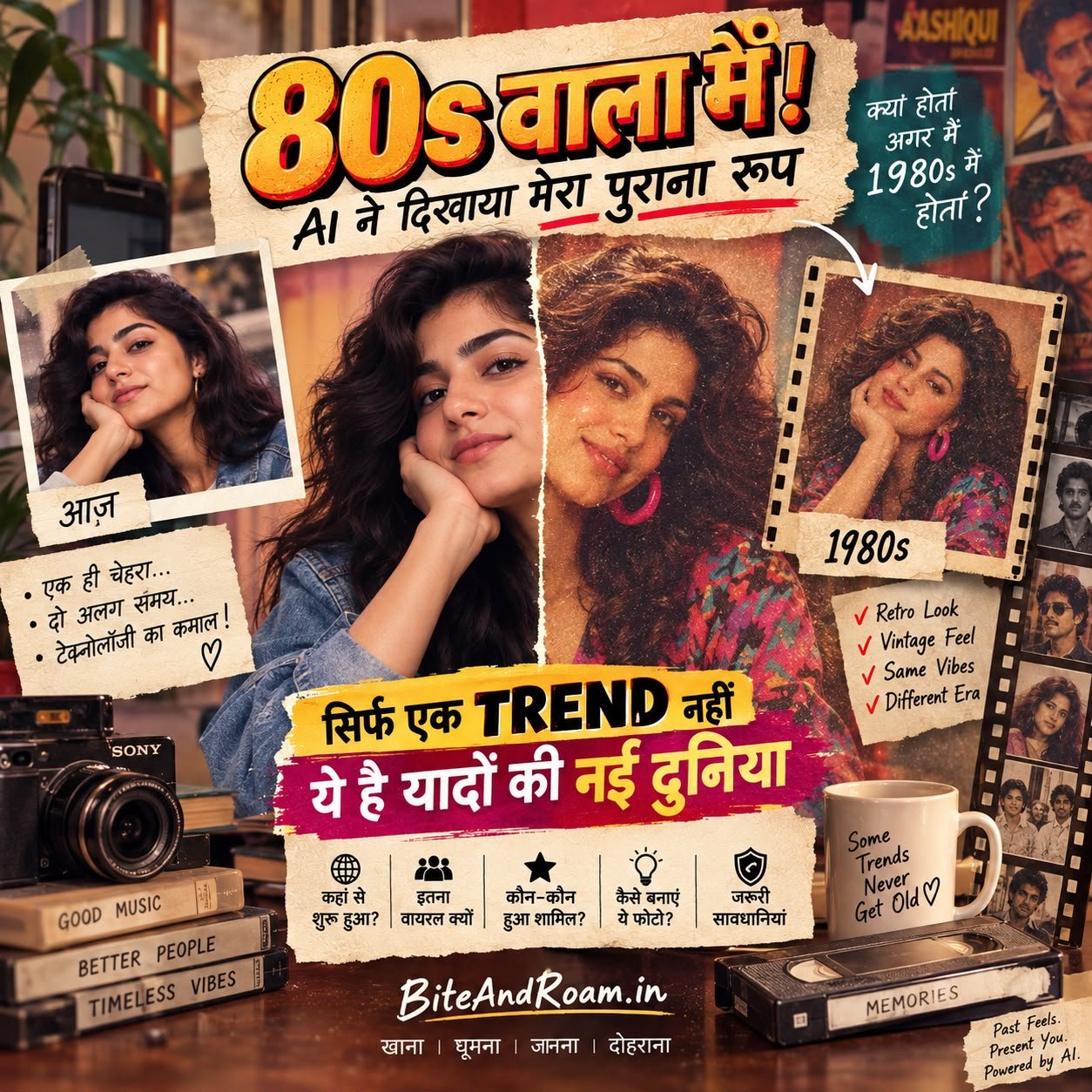
In September 2026, one particular trend has taken over Instagram and other social platforms: the 80s AI Photo Trend.

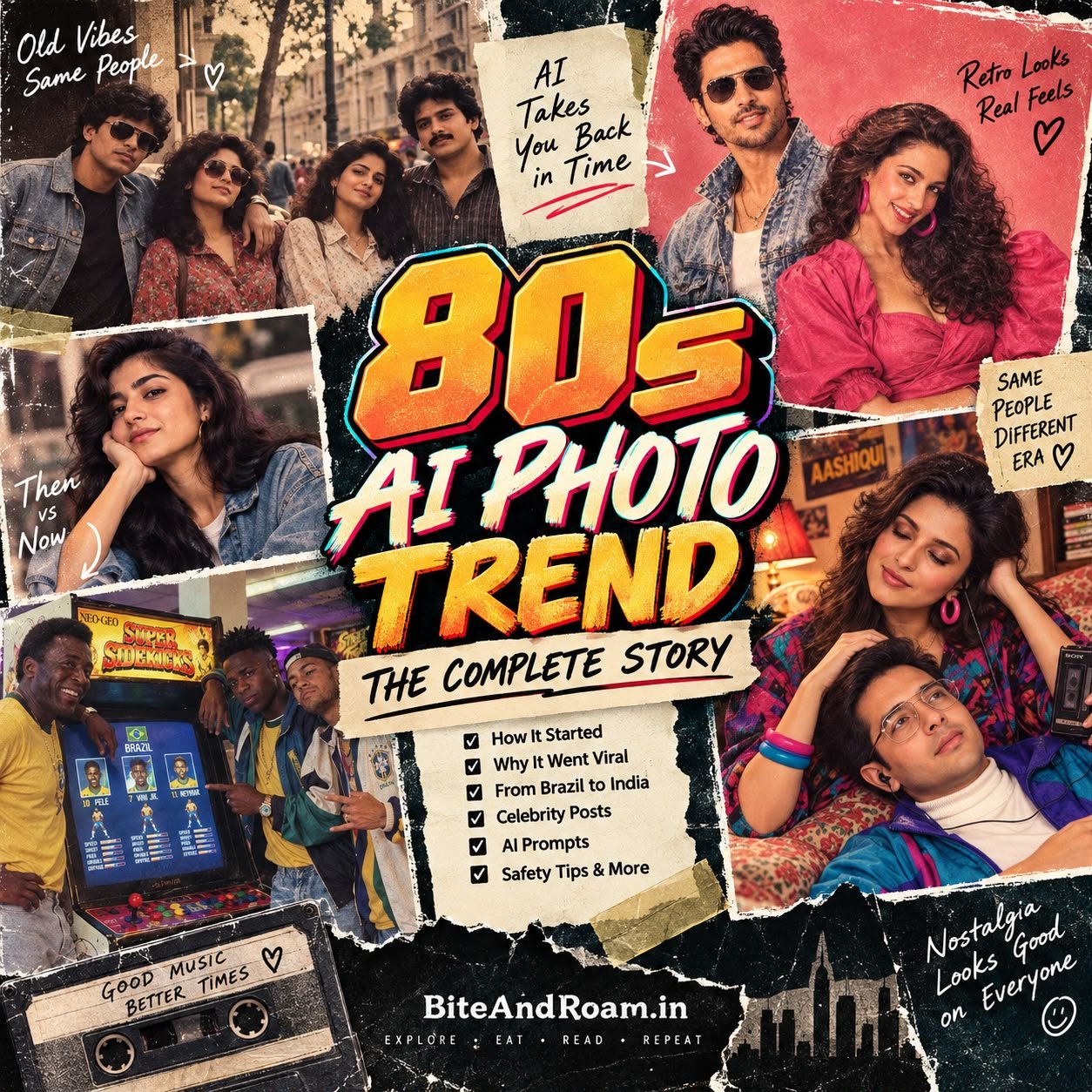
Suddenly, people are sharing photographs that look as if they were taken four decades ago. Old-school hairstyles, vintage clothes, colourful backgrounds, film grain, retro lighting and classic Bollywood-inspired poses have flooded social media feeds.
But there is one fascinating detail behind these photographs:
Most of them were not actually taken in the 1980s.
They were created in 2026 using Artificial Intelligence.
The trend allows people to take a modern photograph of themselves and transform it into a realistic-looking portrait inspired by the 1980s.
But how did this trend start?
Who created it?
Why did people suddenly become obsessed with looking like their parents’ generation?
How did a trend that began appearing in Brazil reach India and become popular among celebrities, influencers and public figures?
Let’s take the complete journey of the 80s AI Photo Trend.
⸻
What Exactly Is the 80s AI Photo Trend?
The 80s AI Photo Trend is a form of generative AI photography in which people use an AI image-generation tool to recreate their modern photographs in the visual style of the 1980s.
Instead of simply applying a vintage filter, AI can reinterpret the entire image.
It can change or recreate elements such as:
* Hairstyles
* Clothing
* Accessories
* Backgrounds
* Lighting
* Camera style
* Colours
* Poses
* Film texture
* Overall atmosphere
For example, someone might upload a modern selfie wearing a T-shirt and jeans.
With the right prompt, AI can transform the image into a realistic-looking 1980s portrait featuring retro clothing, an old-fashioned hairstyle, vintage sunglasses, a studio background and analogue film texture.

That is what makes the trend different from an ordinary Instagram filter.
A filter changes the appearance of an existing photograph.
Generative AI can create a new visual interpretation of that photograph.
⸻
Who Started the 80s AI Photo Trend?
This is probably the biggest question surrounding the trend.
There is currently no officially confirmed single person who can be identified as the creator of the 80s AI Photo Trend.
According to reporting around the trend, its early viral wave appeared in Brazil during the first week of September 2026, particularly through Instagram Stories.
Rather than being launched as an official campaign by a celebrity or technology company, the trend appears to have grown organically as people began sharing their own AI-generated 1980s portraits.
Some reports trace the early spread to Instagram’s “Add Yours” format, where one person shares a particular type of content and invites others to participate with their own versions.
This created a chain reaction.
One person posted a retro AI portrait.
A follower saw it.
The follower created their own version.
Their friends saw it.
They created theirs.
And the cycle continued.
Because Instagram Stories disappear after 24 hours, identifying the very first person who created the image is difficult.
Therefore, it would be inaccurate to claim that a particular celebrity or influencer officially invented the trend without reliable evidence.
The more accurate description is that the trend appears to have grown organically through social media users before becoming a much larger global phenomenon.
⸻
How Did the Trend Spread From Brazil?

The early concept was surprisingly simple.
People wanted to see what they might have looked like during the 1980s.
Using AI image-generation tools, they began recreating themselves in the fashion and photography styles associated with that decade.
Once these images started appearing on Instagram Stories, other users wanted to try the same thing.
The “Add Yours” format made participation even easier.
Instead of simply looking at someone else’s photograph, users could become part of the trend themselves.
This is one of the most powerful mechanisms behind social media virality.
People don’t just consume the content.
They recreate it.
That distinction is important.
A normal viral photograph may receive millions of views.
A participatory trend can create millions of pieces of content because every viewer has the opportunity to become a creator.
The 80s AI trend had exactly that quality.
⸻
Why Did People Choose the 1980s?
This is where the trend becomes more interesting than just another AI filter.
Why the 1980s?
Why not the 1990s or 2000s?
The answer lies largely in nostalgia and visual identity.
The 1980s had a very distinctive visual style.
Think of:
* Big hairstyles
* Oversized sunglasses
* Colourful shirts
* Wide collars
* Denim
* Statement jewellery
* Dramatic poses
* Studio portraits
* Analogue film grain
* Colourful backgrounds
* Bollywood-inspired fashion
Even people who were not alive during the decade can recognise the visual language of the 1980s.
Movies, old family albums, television shows, music videos and photographs have preserved that aesthetic.
That makes the 1980s particularly easy to recognise and recreate using AI.
⸻
The Nostalgia Factor
Nostalgia is one of the biggest reasons behind the popularity of the trend.
For older generations, the 1980s can represent their youth, school years, college life, first jobs, weddings or early family memories.
For younger generations, the decade represents something they never personally experienced.
And that creates an interesting situation.
A teenager born decades after the 1980s can now use AI to create a photograph that looks as if they were part of that era.
In other words, AI is allowing people to create imaginary memories.
The photograph may never have existed.
The event may never have happened.
But the image can still look like a believable piece of history.
That is one of the reasons this trend feels different from a normal fashion challenge.
⸻
When Celebrities Joined the Trend
The trend became significantly more visible once celebrities and public figures began participating.
In India, several well-known celebrities embraced the retro AI aesthetic.
Kiara Advani and Sidharth Malhotra shared a retro-inspired AI image portraying themselves with a distinctly 1980s Bollywood-style appearance.

Parineeti Chopra and Raghav Chadha also joined the trend with a colourful retro-inspired image.

Other celebrities reported to have participated included Ameesha Patel, Shruti Haasan, Kajal Aggarwal, Tahira Kashyap, Saba Ali Khan, Nushrratt Bharuccha, Abhay Verma, Randeep Hooda and Lin Laishram.
Ameesha Patel’s version particularly leaned into the exaggerated fashion associated with the era, including bright styling and retro accessories.
Once these celebrities started sharing their versions, the trend received an enormous boost in visibility.
Millions of followers were suddenly exposed to the concept.
And the obvious next question became:
“What would I look like in the 1980s?”
⸻
Politicians Joined the 80s AI Craze Too
The trend did not remain limited to Bollywood and entertainment.
Indian politicians and public figures also began participating.
Piyush Goyal shared an AI-generated retro portrait featuring a classic 1980s-inspired appearance, including vintage styling and aviator sunglasses.

Kiren Rijiju also joined the trend.
Interestingly, Rijiju later shared an actual photograph from his younger years, creating a humorous contrast between an AI-generated 1980s version and a real photograph from that period.

Himanta Biswa Sarma also participated in the trend, while other public figures including Anurag Thakur and Chirag Paswan were reported to have embraced the retro AI style.
Shashi Tharoor took a slightly different approach.
Instead of relying entirely on AI-generated nostalgia, he shared genuine photographs from the 1980s, showing what he actually looked like during that period.
This created an interesting contrast:
AI-generated memories versus real memories.
⸻
Why Did the Trend Become So Viral
There is no single reason behind its popularity.
Several factors came together.
1. It Is Personal
The most important element is that the person in the image is you.
People are naturally more interested in content that involves their own identity.
Seeing yourself as a superhero might be entertaining.
But seeing yourself as a person from another decade feels strangely personal.
⸻
2. The Transformation Is Dramatic
The difference between the original photograph and the AI version can be enormous.
A modern selfie can suddenly become a vintage studio portrait.
A modern outfit can become a classic 1980s outfit.
A smartphone photograph can become something that looks as though it came from an old family album.
The transformation itself is highly shareable.
⸻
3. It Is Easy to Participate
You don’t need professional photography equipment.
You don’t need Photoshop skills.
You don’t need a professional photographer.
You simply need a suitable photograph and access to an AI image-generation tool.
That low barrier to entry made it extremely easy for ordinary users to participate.
⸻
4. Celebrities Made It More Visible
When celebrities participate in a trend, their enormous audiences can expose the trend to millions of people almost instantly.
Once people saw familiar Bollywood stars appearing in retro AI portraits, the concept became much more mainstream.
Instead of being something happening inside a small online community, it became a trend that ordinary Instagram users could easily recognise.
⸻
5. The Prompts Became Viral Too
Another interesting part of this trend is that people were not only sharing the final photographs.
They were also searching for the AI prompts used to create them.
Questions such as:
“Which prompt was used?”
“How can I create this?”
“What should I write in ChatGPT?”
became part of the trend itself.
That created another cycle of content.
One person created an image.
Another person explained the prompt.
A third person created a tutorial.
A fourth person made a Reel showing the transformation.
And suddenly the trend had multiple types of content surrounding it.
⸻
Why Does the AI Version Look So Real?
Modern generative AI models can understand many visual characteristics associated with a particular period.
When a user describes a 1980s photograph, the AI can attempt to recreate details such as:
* Analogue film grain
* Older camera characteristics
* Period fashion
* Vintage hairstyles
* Retro colour palettes
* Studio lighting
* Older photographic compositions
The result does not necessarily represent a real historical photograph.
Instead, it is a newly generated image designed to visually resemble photography from that period.
That distinction is extremely important.
⸻
The Difference Between a Vintage Filter and AI
This trend also highlights how much image technology has changed.
A traditional vintage filter generally takes an existing photograph and modifies its colours, contrast and texture.
AI image generation can go much further.
It can reinterpret the scene.
It can imagine different clothes.
It can recreate a different environment.
It can change the overall photographic style.
That is why the results can feel much more dramatic.
The technology isn’t simply making the photo look old.
It is attempting to imagine:
“What would this person have looked like if this photograph had been taken in the 1980s?”
⸻
The Indian Version Became Especially Bollywood-Inspired
Once the trend reached India, its visual identity naturally began to reflect Indian popular culture.
The 1980s in India had a very recognisable Bollywood aesthetic.
Bright colours.
Dramatic poses.
Big hairstyles.
Vintage cars.
Colourful studio backgrounds.
Oversized sunglasses.
Statement fashion.
Classic film-poster compositions.
AI can combine these visual elements into a single portrait.
That is why Indian versions of the trend often look different from the original international versions.
The technology may be the same, but the cultural references change.
⸻
The Most Interesting Part: People Are Creating an Imaginary Past
Perhaps the deepest idea behind the trend is that people are no longer using AI only to imagine the future.
They are using it to recreate the past.
Imagine a teenager asking:
“What would I have looked like in 1985?”
The person obviously cannot have a real photograph from that moment.
But AI can create a visual interpretation.
The same thing can happen with families.
Someone can create a fictional 1980s family portrait.
Someone can imagine themselves as a Bollywood actor from that era.
Someone can recreate a retro wedding.
Someone can create an old-school college photograph.
The possibilities are almost endless.
⸻
But There Is a Problem: AI Images Are Not Historical Evidence
This is where users need to be careful.
An AI-generated 1980s photograph is not proof that the event actually happened.
It is a creative reconstruction.
A person might appear to be wearing clothes they never owned.
They might appear in a location they never visited.
They might appear alongside people they never met.
The image can look authentic without being historically authentic.
That is why AI-generated photographs should be clearly understood as generated or edited content when the context could otherwise be misleading.
⸻
The Cybersecurity Side of the Trend
Every major viral trend eventually attracts scammers, and the 80s AI craze is no exception.
Cybersecurity warnings have emerged around fake websites and suspicious links claiming to generate retro AI photographs.
Some malicious links may attempt to convince users to download unknown APK files or provide sensitive information.
This creates a simple but important rule:
Never download an unknown application just because a viral trend tells you to.
If someone sends you a random link saying:
“Create your 80s photo here!”
don’t automatically trust it.
Use a reputable AI service instead, and check what permissions and data the service requires before uploading personal photographs.
A viral photograph is not worth compromising your privacy or device security.
⸻
Will the 80s AI Trend Last?
The viral phase will eventually slow down.
That is normal for social media.
But the technology behind the trend is unlikely to disappear.
Today people are recreating the 1980s.
Tomorrow they may recreate the 1990s.
After that, someone might ask AI to show what they would look like in the year 2050.
The bigger trend is not actually “80s photography.”
It is the ability to use AI to create alternate versions of ourselves.
That is much bigger than a single Instagram challenge.
⸻
What the 80s AI Trend Tells Us About the Future of Photography
For decades, photography had one basic purpose:
To record something that happened.
Generative AI introduces another possibility:
To visualize something that never happened.
That is a major change.
A traditional family photograph might document a real wedding.
An AI-generated retro wedding photograph might show what the same family could have looked like at a fictional wedding in 1985.
Both can look like photographs.
But they represent completely different things.
Understanding that difference will become increasingly important as AI-generated images become more realistic.
⸻
From Brazil to India: The Journey of a Viral Trend
The story of the 80s AI Photo Trend is ultimately a story about how modern social media works.
It appears to have emerged organically through Instagram users in Brazil in early September 2026.
Instagram Stories and participation-based features helped people recreate the idea.
The trend then spread beyond its original audience.
As celebrities and public figures adopted it, the visibility increased dramatically.
Indian celebrities brought their own Bollywood-inspired interpretation.
Politicians and other public figures joined.
Influencers created tutorials.
Ordinary users started making their own versions.
And within a short period, the trend became one of the most recognisable AI photo trends on social media.
There was no single official launch.
There was no confirmed founder.
There was no one person responsible for every stage of its growth.
Instead, thousands of users collectively transformed a simple idea into a global social-media trend.
⸻
Final Thoughts
The 80s AI Photo Trend may look like a simple Instagram craze.
But behind the colourful hairstyles, vintage clothes and retro photographs is something much more interesting.
It represents a new relationship between people and photography.
For the first time, people can easily create photographs of themselves in periods they never experienced.
They can create fictional memories.
They can imagine alternate versions of their lives.
They can turn a modern selfie into something that looks as though it came from an old family album.
The trend appears to have begun as an organic social-media phenomenon rather than as an officially launched campaign by one individual.
From early Instagram activity in Brazil, it travelled across social platforms and eventually became a major trend in India.
Celebrities such as Kiara Advani, Sidharth Malhotra, Parineeti Chopra, Raghav Chadha and Ameesha Patel helped bring enormous visibility to the retro aesthetic, while several other entertainment figures and public personalities joined the conversation.
Indian public figures and politicians also experimented with the trend, creating another layer of attention and discussion.
But perhaps the most fascinating part is that nobody really needs to know the original creator anymore.
The internet took the idea and turned it into something much larger.
One person created a photograph.
Another person recreated it.
A celebrity shared one.
Millions of people followed.
And suddenly, an entire generation began asking the same question:
“What would I have looked like in the 1980s?”
The 1980s did not actually come back.
AI simply gave us a way to imagine that it did.
And that may be the real reason the 80s AI Photo Trend became so addictive, so shareable and so surprisingly powerful.
Community Discussions (0)
Leave a comment or food tip
No comments yet. Be the first to share your thoughts!