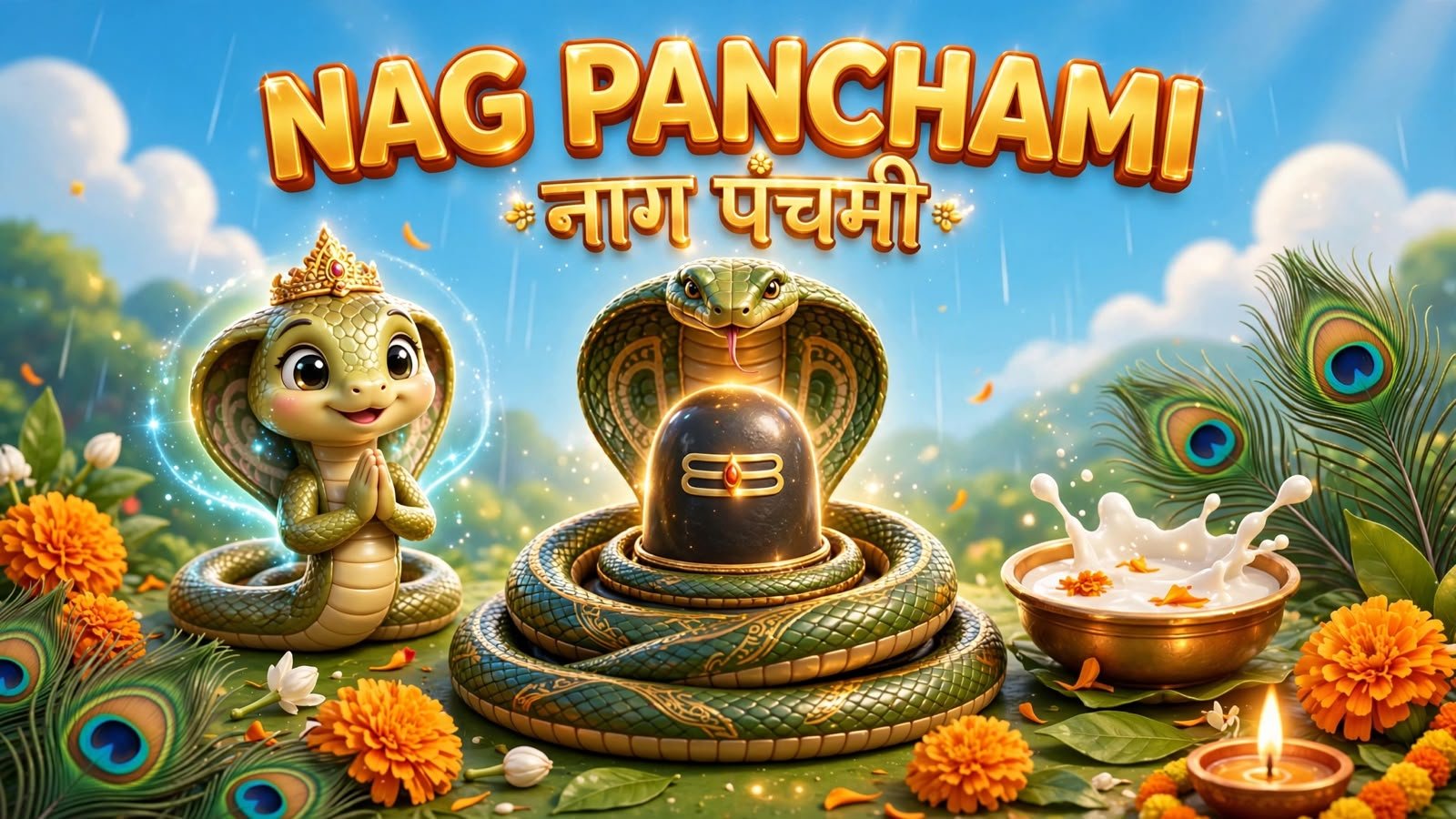
Nag Panchami is one of the most ancient and sacred festivals of Hinduism. It is celebrated every year on the fifth day (Panchami) of the bright half (Shukla Paksha) of the holy month of Shravan. The month of Shravan is dedicated to Lord Shiva, who wears Vasuki Nag around his neck.
Section 1: What is Nag Panchami and When is it Celebrated?

Nag Panchami is one of the most ancient and sacred festivals of Hinduism. It is celebrated every year on the fifth day (Panchami) of the bright half (Shukla Paksha) of the holy month of Shravan. The month of Shravan is dedicated to Lord Shiva, who wears Vasuki Nag around his neck.

Worshipping the Nag Devtas on this day is believed to remove Kaal Sarp Dosh and bring prosperity and happiness to the family.
Section 2: How and When Did Nag Panchami Start? - The Historical Story
The origin of Nag Panchami is linked to the Mahabharata era.
According to the legend, King Janamejaya, the grandson of Arjuna, organized a massive Nag Yagya to avenge his father Parikshit's death, who was bitten by Takshak Nag.

In this Yagya, all the Nagas were being pulled into the fire.
Then, a sage named Astika Muni, whose father was a Brahmin and mother was from the Naga clan, came and stopped the Yagya.

The day he stopped the Yagya was Shravan Shukla Panchami. The lives of all the Nagas were saved. Since then, Nagas promised that whoever worships Nagas on Panchami will never have to fear snakes. From that day, this festival is celebrated.
Some historians also link its origin to the Indus Valley Civilization where images of Nagas have been found, which means snake worship in India is more than 5000 years old.
Section 3: Why is Nag Panchami Celebrated? - 3 Main Mythological Stories
1. Samudra Manthan Story:

During the churning of the ocean, Vasuki Nag was used as the rope for churning. He played a vital role.
2. Lord Krishna and Kaliya Nag Story:

When Kaliya Nag poisoned the Yamuna river, young Lord Krishna jumped into the river, defeated Kaliya Nag and danced on his hood. This day is also celebrated as Nag Panchami.
3. Lord Shiva and Nag:

Nagas are the most beloved ornament of Lord Shiva. Worshipping them in Sawan pleases both Lord Shiva and the Nag Devtas.
Section 4: Puja Vidhi and Traditions
On this day, people wake up early, take a bath, and make an image of a Nag with cow dung on the main door of the house. The Nag deity is worshipped with milk, curd, durva grass, kusha, flowers and rice. At many places, snake charmers are called and milk is offered to real cobras with true devotion. On this day, digging the earth and cutting leafy vegetables is forbidden.
Section 5: Where is Nag Panchami Celebrated Outside India?
This is not just a festival of India, but is celebrated wherever Indian culture has spread.
1. Nepal:

In Nepal, Nag Panchami is celebrated on a very large scale. Nagas are considered the protectors of water. People paste pictures of Nagas on their house doors to prevent evil spirits from entering. A special fair is held at Nag Pokhari in Kathmandu.
2. Mauritius and Fiji:

Among the people of Indian origin settled here, Nag Panchami has great importance and they go to Shiva temples to worship Nagas.
3. Some parts of Bangladesh and Pakistan:

The tradition of worshipping the Naga goddess in the form of Mansa Devi is still alive here.
4. USA, UK, Canada and Australia:

The Indian community living here gathers in temples to organize Nag Panchami puja and Katha.
Section 6: Scientific and Environmental Importance
Nag Panchami is not just a religious festival, but it is deeply connected with the environment. In the month of Sawan, it rains heavily and snakes come out of their holes. Our ancestors created the tradition of worshipping snakes instead of killing them, so that the balance of the ecosystem remains. Snakes eat rats and protect our crops.
Conclusion:
Nag Panchami is a symbol of respect and coexistence between nature and humans. It teaches us that every living being on this earth has its own importance.
Community Discussions (0)
Leave a comment or food tip
No comments yet. Be the first to share your thoughts!